One of the easiest ways to turn a flooring project into a headache is to order the exact square footage of the rooms and assume you are finished.
If your house measures 1,200 square feet, that does not automatically mean you should buy exactly 1,200 square feet of LVP. You need enough material for cuts, closets, damaged pieces, layout adjustments and future repairs—and flooring is sold by the box, not by the exact square foot.
At Case Floors of the Panhandle, we help customers calculate flooring quantities every day. Here is the simple way to think about it.
Step 1: Measure the Actual Areas You Are Flooring
Start by breaking the project into rectangles. Measure the length and width of each room, hallway, closet and connected space that will receive flooring.
Multiply length by width to get square footage:
Length × Width = Square Feet
For example, a room that measures 12 feet by 15 feet is 180 square feet.
Do that for each area and add the totals together. If a room is irregular, divide it into smaller rectangles instead of trying to estimate the whole shape at once.
Do Closets Count?
Yes—if you are flooring them.
Closets are one of the most common places people forget. A few small closets may not sound like much, but once you add a pantry, linen closet, bedroom closets and a utility area, the missing square footage can add up quickly.
On the other hand, do not count areas where the flooring will not be installed. For a floating-floor project, fixed cabinetry and permanent built-ins may affect the layout, so make sure the installer or project plan is clear about where the floor starts and stops.
Step 2: Add Waste
Waste is not “extra flooring you probably will not need.” It is part of the installation.
Every room requires cuts. The last plank in one row may not start the next row. Doorways, closets, angles and transitions create offcuts. Some pieces may have a damaged corner or a visual feature you would rather use in a less noticeable area.
For many straightforward rectangular layouts, customers often plan on roughly 7% to 10% extra. More complicated layouts, lots of small rooms, unusual angles or a specific plank-layout plan can require more.
The installer should make the final call on waste for a complicated project, but ordering zero waste is almost always too tight.
A Simple Example
Suppose your measured flooring area is 1,200 square feet.
- 1,200 sq. ft. + 7% = 1,284 sq. ft.
- 1,200 sq. ft. + 10% = 1,320 sq. ft.
You would then convert that target into whole boxes based on the square footage contained in the exact product you are buying.
If the math says you need 68.2 boxes, you do not order 68.2 boxes. You round up to 69 boxes.
Step 3: Remember That Every Product Has a Different Box Quantity
Do not assume every LVP box covers the same amount of floor. Coverage changes with plank width, plank length and the number of planks packed in each carton.
This matters when you are comparing products. Two colors can have the same price per square foot but a different number of square feet per box, which means the box price will look different.
Always do the final order calculation using the square feet per box printed for the exact product.
Why We Usually Recommend Keeping Extra Flooring
If your budget and storage space allow it, keeping one or two unopened boxes after the project can be very useful.
Years from now, you may need to replace a plank after a plumbing repair, appliance leak, wall move or accidental damage. Flooring colors and collections change. Even when a similar color still exists, a future production run may not be an exact visual match to the floor already in your home.
An extra box from the original order is cheap insurance compared with trying to match an older floor later.
What About Production-Lot Differences?
LVP is manufactured in production runs. Good manufacturers maintain tight color control, but small visual differences between production lots can happen.
That is another reason it is better to buy enough material at the beginning rather than discovering halfway through the job that you need three more boxes from a later shipment.
If you are ordering a whole-house project, make sure the quantity is settled before installation begins whenever possible.
The “I’ll Just Come Back for More” Problem
Sometimes customers intentionally order tight because they do not want extra boxes sitting around. That can work—until the installer is one box short on a Saturday afternoon.
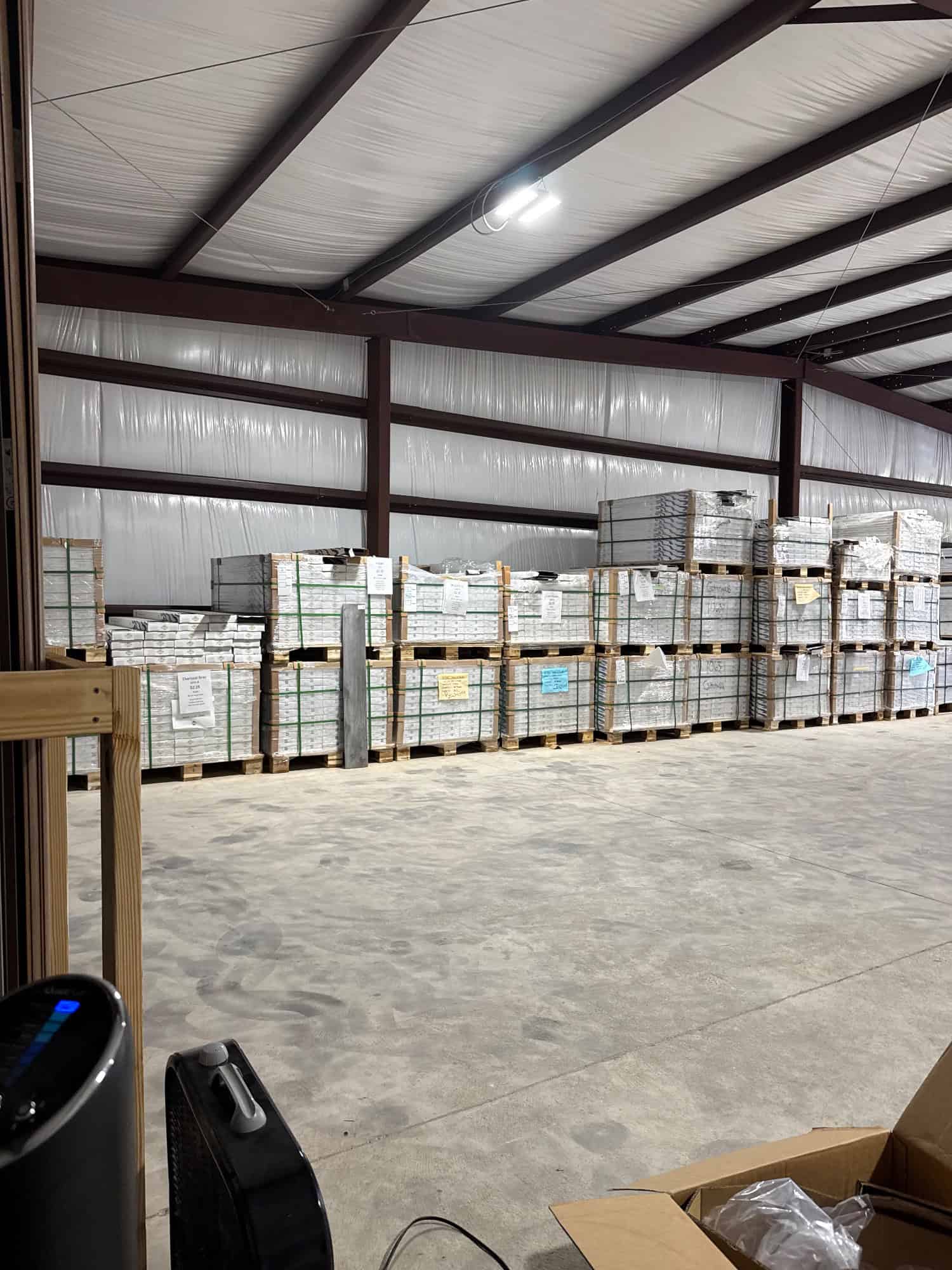
Even with a warehouse that keeps a large amount of flooring in stock, inventory moves. A popular color can sell quickly, and a future shipment may be a different production run.
The goal is not to wildly over-order. The goal is to order enough that the installer can complete the job without stopping and without treating every cut like the last plank on earth.
How Room Shape Changes the Waste Percentage
A simple open rectangle is efficient. A house with six closets, several short hallways, angled walls and multiple doorways is not.
More cuts usually mean more waste. Plank direction matters too. If the room layout forces many short starter or end pieces, material usage can increase.
This is why two 1,500-square-foot houses do not always require the exact same amount of flooring.
Should You Subtract Kitchen Cabinets?
Do not make that decision from the square-footage calculator alone.
Floating LVP generally should not be trapped beneath fixed cabinetry, so the final flooring footprint depends on the project layout and installation plan. In a remodel, the cabinets may already be installed. In a new build, the order of operations matters.
If you are unsure, measure the room and let the installer or flooring supplier help determine the actual flooring area instead of guessing.
Do You Need to Order Extra for Stairs?
Yes, if the same LVP is being used as part of the stair design. Stairs create cuts and may require coordinating stair noses or other trim pieces. They should be calculated separately rather than lumped into the room square footage.
Do Not Forget Transitions and Trim
The plank quantity is only one part of the order. Depending on the project, you may also need transitions, stair nose, quarter round, shoe molding or a moisture-control product.
Doorways and changes between flooring types are easiest to plan before the material leaves the warehouse. Walking the project and counting transitions ahead of time can save an extra trip later.
A Quick Flooring Quantity Checklist
- Measure every room that will receive flooring.
- Include hallways and closets.
- Break odd-shaped rooms into smaller rectangles.
- Add the appropriate waste percentage for the layout.
- Check the exact square feet per box for your selected color.
- Round up to a whole box.
- Consider keeping one or two unopened boxes for future repairs.
- Count transitions, stair pieces and trim separately.
What If You Order Too Much?
It is worth understanding the return policy before ordering. Case Floors accepts qualifying returns under our posted return terms, but the smartest plan is still to measure carefully and order an appropriate amount from the start.
You can review the current policy on our LVP Flooring FAQs page.
Bring Us Your Measurements
If you have room measurements but are not sure how many boxes to buy, bring them to Case Floors of the Panhandle. We can calculate the material quantity for the product you choose and help you account for box coverage and reasonable waste.
If you are still choosing a color, our real-room guide to popular LVP wood tones can help narrow the options before you visit.
Visit us at 4350 Floridatown Road in Pace or call 850-287-1889.